Sending a quote or proposal so it reaches the decision-maker you have never met
Published
Few stretches of work are as uneasy as the days after a quote goes out. You sharpened the price as far as it would go and you believe in the proposal. What comes back is a two-line note saying they are going another way this time.
Most of the time, the reason you lost had less to do with what was inside the quote than with what happened around it.
The person you met is usually not the person who approves the spend. Your quote leaves their hands, goes to their manager, and travels through a company you cannot walk into. You are not in the room where it is decided.
This guide covers what to do about that, on the assumption that someone you have never met will read the document — with an email template you can use as it stands.
1. Your quote does the selling you cannot be there to do
Even at a small company, spending above a certain size goes through an internal approval round, and taking quotes from several suppliers to compare is entirely normal.
What the approver actually holds is a handful of quotes and a short explanation from your contact. They do not know your company. None of the goodwill from the meeting, and none of your own manner, travelled with the document. What they have to judge on is the number and the impression the paperwork gives.
What is easy to miss is that your contact also has someone to convince.
Backing a supplier nobody has heard of takes something to point at. When their manager asks whether this company is really the safe choice, does your contact have an answer ready?
So the person you are really helping when you send a quote is your contact. Hand them a set of material that makes the case easy to make internally, and they will carry it for you.
2. Getting the document itself right
Name the file as though it will be forwarded
Send something called quote_final.pdf and your contact has to rename it before passing it upward. Saving them that step costs you nothing and changes how the document lands.
With the client name, the project and the date in it, your quote is still identifiable when it sits in a busy inbox next to two competitors.
- State the scope and the assumptions
- The worst position to be in during a comparison is looking simply more expensive. If the reason for the gap is not written down, an approver has nothing to read but the number. Spell out what the price covers, what it does not, and what you assumed — supplied material, how many rounds of revisions, the schedule. That alone lets the approver look at a much cheaper rival and think, so that one is cheaper because it leaves that work out.
- Put a summary on page one
- A busy approver does not read every page. If page one says what, how much and by when, the decision has a foundation. Line-item detail is fine from page two onward.
- Give it an expiry date
- A quote with no expiry date is easy to postpone. A date creates a point by which their side has to decide.
3. What to send alongside it
Three things are enough to make your contact’s internal case easy to make.
- A company introduction
- A one-to-two-minute video, or about five slides. What you do and what you are good at is enough.
- One to three comparable projects
- Work for the same industry, or for a client of roughly the same size.
- A face and a contact
- Knowing who they would actually be dealing with takes a good deal of the risk out of an unfamiliar supplier.
The trap here is sending too much. A thirty-page company brochure reads as enthusiasm to you and as work to them, and it will not be opened. Trim it to what an approver can take in during a few minutes and more of it gets read.
The problem with separate attachments
Attach the quote, the introduction and the case studies as three separate files and what usually happens is that only the quote gets forwarded.
Your contact is busy. Passing it up, they pick the one file that looks most important. Everything you prepared to make your case stays behind in their inbox.
The reliable fix is to send the material as one set, received through a single link. If there is only one thing to forward, there is nothing to pick from.
4. Ask to have the approver on the email
One more thing carries a lot of weight, and it happens before you send: ask.
“If anyone else will be reviewing this internally, shall I include them on the message as well?”
From your contact’s side it is a helpful offer that saves them forwarding it. From yours, it shows you who actually decides. If they say no, you have lost nothing.
When the material reaches the approver directly, it is read without passing through a summary. That by itself improves where you stand against the other quotes.
5. Why send a small quote through a file service at all
A quote in PDF is a few hundred kilobytes. On size alone, there is nothing wrong with attaching it to an email.
The reason we still suggest a transfer service has nothing to do with capacity. It is about what you can put around the quote.
The first thing they see is a screen, not a file
On the FILE SHIPPER Business plan, the download page the recipient lands on carries your company name, your logo and your own subdomain. No third-party advertising appears on it.
Before they open the PDF, they see your company. An approver who has never met you gets a sense of the firm before the bare number — which a plain email attachment cannot do.
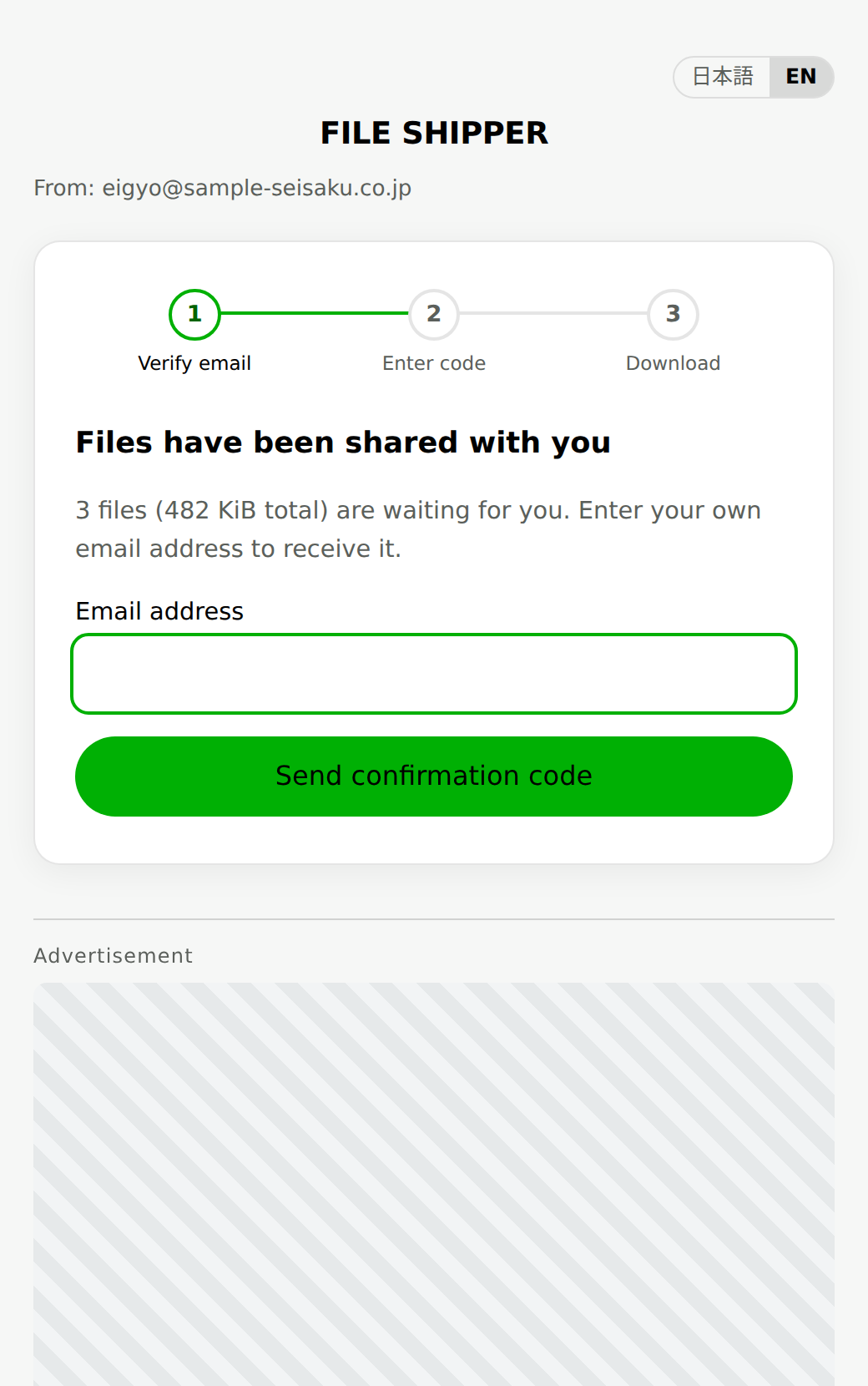
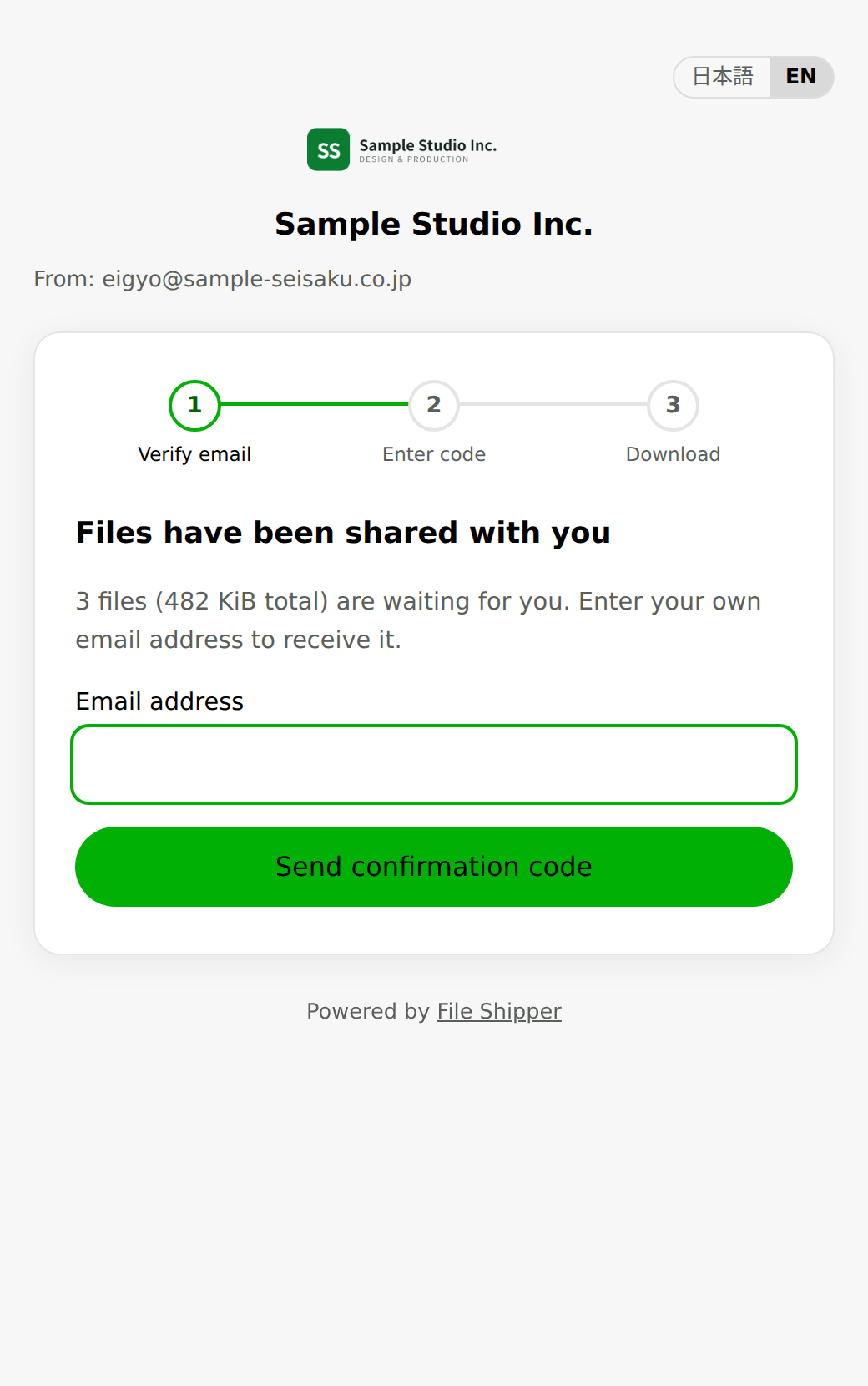
The same share — a quote, a company introduction and two case studies, 482 KiB in total — captured twice with only the plan changed. The advertising version is the free plan (the ad slot is a placeholder, not a real creative); the branded version is Business. The company, logo and subdomain are fictional.
Putting your introduction next to the quote
Your company video, slides and case studies can sit on the download page beside the files. Send the quote, the introduction and the case studies together and the recipient takes them as one set — which is also what stops the quote being forwarded on its own.
To be straight about the mechanics: video and slides are shown by pasting a public URL from YouTube, Vimeo, Speaker Deck, SlideShare or Google Slides — it is not somewhere to host a video file itself. Document files shown alongside are capped at 20MB each, ten per set. Given that a thick brochure is the thing least likely to be read anyway, we think that limit sits about right.
No account for the recipient
A recipient enters their email address and a one-time code, so there is no account to create. The other side of that is that a forwarded link is of no use to anyone but the addressee. It also sidesteps the growing number of companies whose systems reject password-protected zips.
The quote’s expiry and the link’s expiry are different clocks
This gets misread, so plainly: an approval round running for weeks is ordinary, but a download link lasts at most 7 days on the FILE SHIPPER Business plan (one day on the free plan). Keeping a link alive until the decision lands is not a thing you can do.
The practical answer is simple — keep the original to hand, so you can always offer to send it again. Offering a fresh link as the date approaches is also a natural reason to follow up. The expiry printed on the quote, which is how long you stand behind the price, has nothing to do with the link.
6. An email template
Listing what you sent, as a list, gives your contact the first draft of their own internal explanation. Make it something they can copy when they forward it and you have taken one job off their desk.
Dear [Name],

Thank you for your time the other day.

Please find our quote for the work we discussed.

What is included
- Quote (valid until [date])
- About us (5 slides)
- Two comparable projects

Download
[link]
Available until [date]. If the link expires, let me know and I will send a fresh one.

If anyone else will be reviewing this internally, I am happy to send it to them directly — just let me know who to add.

Please do get in touch with any questions.

Best regards,
[Your name]
The download deadline and the quote’s validity date are two different things. Keeping them on separate lines avoids confusion on their side.
7. After it has gone
If the expiry date is approaching with no reply, getting in touch about three days beforehand is natural enough.
Rather than asking how the decision is going, say that the quote is about to expire and that you are happy to extend it if they need more time internally. It reads as helpful instead of impatient, and it is far easier to reply to.
If you do lose the job, it is still worth asking for one reason. Price, scope, or simply timing — that answer measurably improves the next quote you write.
8. Common mistakes
- Another client’s name left in the document
- Reusing an old quote as a template and missing a company name somewhere in it. Mid-comparison, that one slip reads as carelessness and can decide the outcome on its own. Search the document for both company names before sending — every time.
- An out-of-date company introduction
- Case studies that stop three years ago, an old photograph, a line of business you have since left. People notice these details. Put a date in the calendar twice a year to review it.
- The quote expiring mid-approval
- Approval finally comes through and the quote has lapsed. One message before the date avoids both the reissue and the awkwardness.
- Sending too much
- It reads as enthusiasm to you and as reading to them. Having the nerve to cut it to three points is what gets it read.
Frequently asked questions
- Should a quote be sent as a PDF?
- Yes, PDF is the default. Sent as an .xlsx, the layout can break depending on the recipient’s setup, and the numbers can be altered without anyone intending it.
- Does attaching a company introduction every time look pushy?
- For a first quote it reads as helpful, because it gives your contact something to explain you with internally. For a client you already work with regularly it is unnecessary.
- Is it rude to ask for the approver to be included?
- Offered as something you are happy to do if they would like it, no. It saves your contact forwarding it, so it is usually welcomed.
- Can I send a quote as a password-protected zip?
- A growing number of companies now block password-protected zips outright on security grounds. Avoid the zip attachment and send by a method that verifies each recipient instead.
- How long does the download link stay valid if approval takes a while?
- With FILE SHIPPER, up to 7 days on the Business plan and one day on the free plan. If the decision will take longer than that, keep the original to hand and send it again when it is needed.
What to do when you are told password-protected zips cannot be accepted
Let them see the company before the number.
Send quotes and proposals on a download page carrying your name, your logo and your company video.